
Google August 2026 Spam Update Concludes: Targeted Spam, AI Content Abuse, and Recovery Principles
🚀 Key Takeaways
- The Google August 2026 Spam Update completed its rollout on August 21st, globally reinforcing existing spam policies.
- The update primarily targeted manipulative tactics, including scaled AI content abuse, cloaking, and doorway pages.
- Community reports indicate significant traffic volatility and drops for many sites, with some niche sites losing rankings to large resellers.
- Experts highlight that SpamBrain is increasingly effective at identifying manipulative patterns, even in seemingly "good" content.
- Recovery from a spam update hit typically takes many months and requires a thorough audit and adherence to Google's spam policies.
- This update underscores Google's commitment to a faster, more frequent update cadence, favoring human-judged value over mass-produced AI content.
The digital landscape has just experienced another significant shift with the Google August 2026 Spam Update officially concluding its rollout on August 21st. This latest enforcement action from Google reinforces its steadfast commitment to combating low-quality and manipulative content across the web, making it a critical topic for every content creator and SEO professional right now.
This update specifically targeted practices such as scaled AI content abuse, cloaking, and doorway pages, among others, demonstrating Google's intensified efforts to clean up search results. As AI-powered writing tools continue to evolve, understanding and adhering to Google's updated enforcement of spam policies is no longer optional but essential for maintaining search visibility and ensuring the long-term health of your online presence.
This update specifically targeted practices such as scaled AI content abuse, cloaking, and doorway pages, among others, demonstrating Google's intensified efforts to clean up search results. As AI-powered writing tools continue to evolve, understanding and adhering to Google's updated enforcement of spam policies is no longer optional but essential for maintaining search visibility and ensuring the long-term health of your online presence.

1. Google's August 2026 Spam Update: What You Need to Know
This section provides the essential, official details of Google's August 2026 Spam Update.Understanding the timeline, scope, and technical nature of this update is the critical foundation for the main article's topic: analyzing the three principles AI-driven blogs must adopt to survive and thrive in this refined enforcement environment.
Rollout Details and Key Characteristics
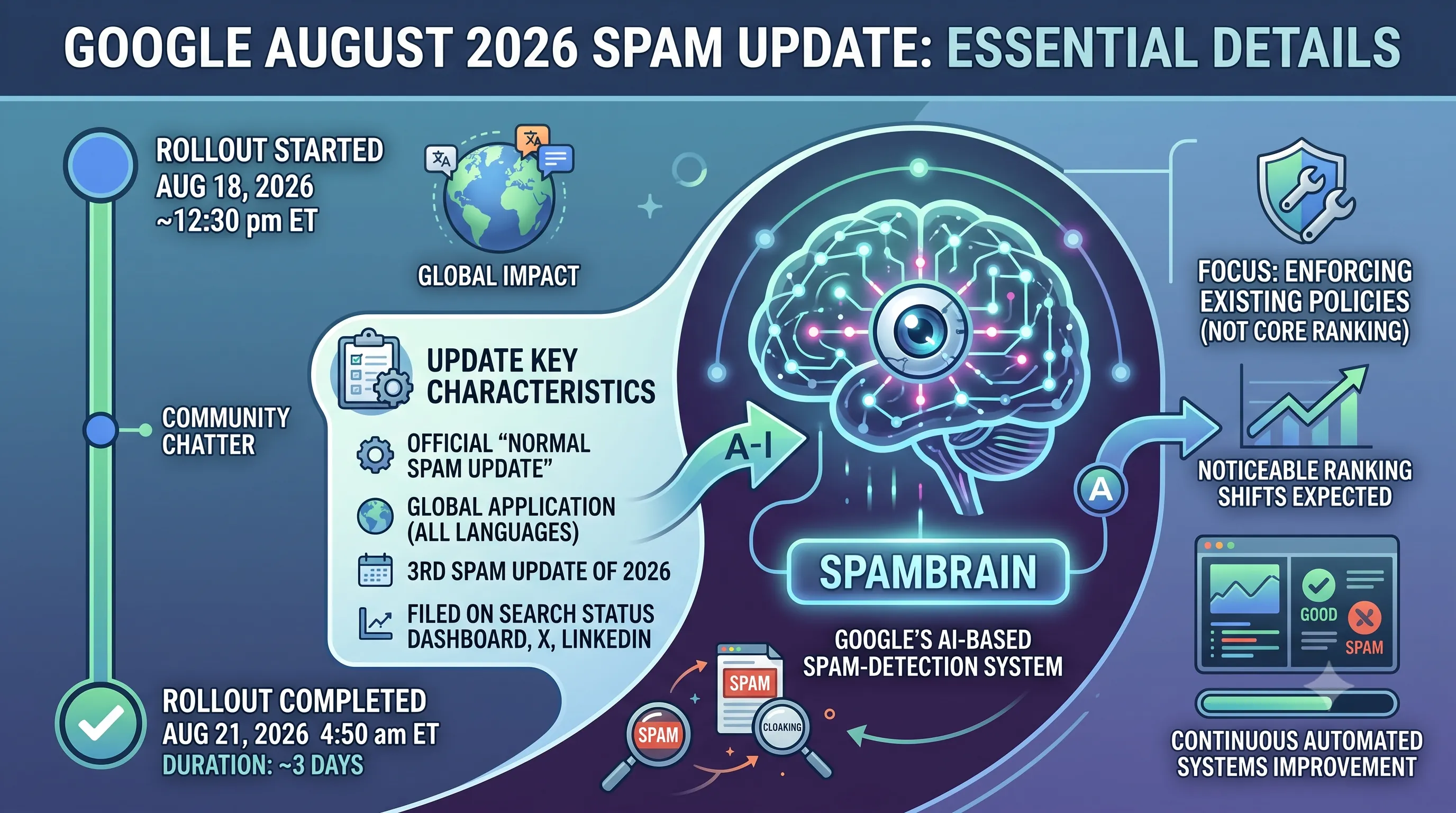
Google has confirmed that the rollout of the Google August 2026 Spam Update is now complete.The update began on August 18, 2026, at approximately 12:30 pm ET (9:27 am Pacific time) and finished on August 21, 2026, at 4:50 am ET.
This marks the third spam-focused update of the year, following previous updates in March and June.
| Event | Date | Time (ET) |
|---|---|---|
| Rollout Started | August 18, 2026 | ~12:30 pm |
| Rollout Completed | August 21, 2026 | 4:50 am |
Google's official announcements, which were posted on the Google Search Status Dashboard, the Google Search Central account on X (formerly Twitter), and LinkedIn, framed the event as a 'normal spam update' with what some described as 'deliberately boring' language.
Interestingly, despite some community sentiment that the update's impact was felt early, Google's John Mueller noted that the update did not start 'soon' relative to its announcement.
SpamBrain's Role in Automated Spam Detection
Spam updates are fundamentally about improving Google's automated systems designed to combat spam.The core of this technology is SpamBrain, Google's proprietary AI-based spam-detection system.
Unlike core updates, which can change how Google ranks content more broadly, spam updates are specifically designed to improve the enforcement of Google's existing spam policies.
Google typically announces these updates when significant modifications to SpamBrain are substantial enough that they are expected to cause noticeable movement in search engine rankings.
2. Specific Spam Policies Enforced: What Was Google Targeting?
This section is foundational to the article's main theme, as understanding precisely what Google penalized is the first step for AI-driven blogs to adapt and thrive.Explicitly Targeted Spam Tactics, Including AI Abuse
The August 2026 spam update was not about creating new rules; it was about enforcing Google's existing search spam policies with greater precision.While Google, in its standard practice for spam updates, did not release an exhaustive list of every tactic, it did highlight several areas of focus.
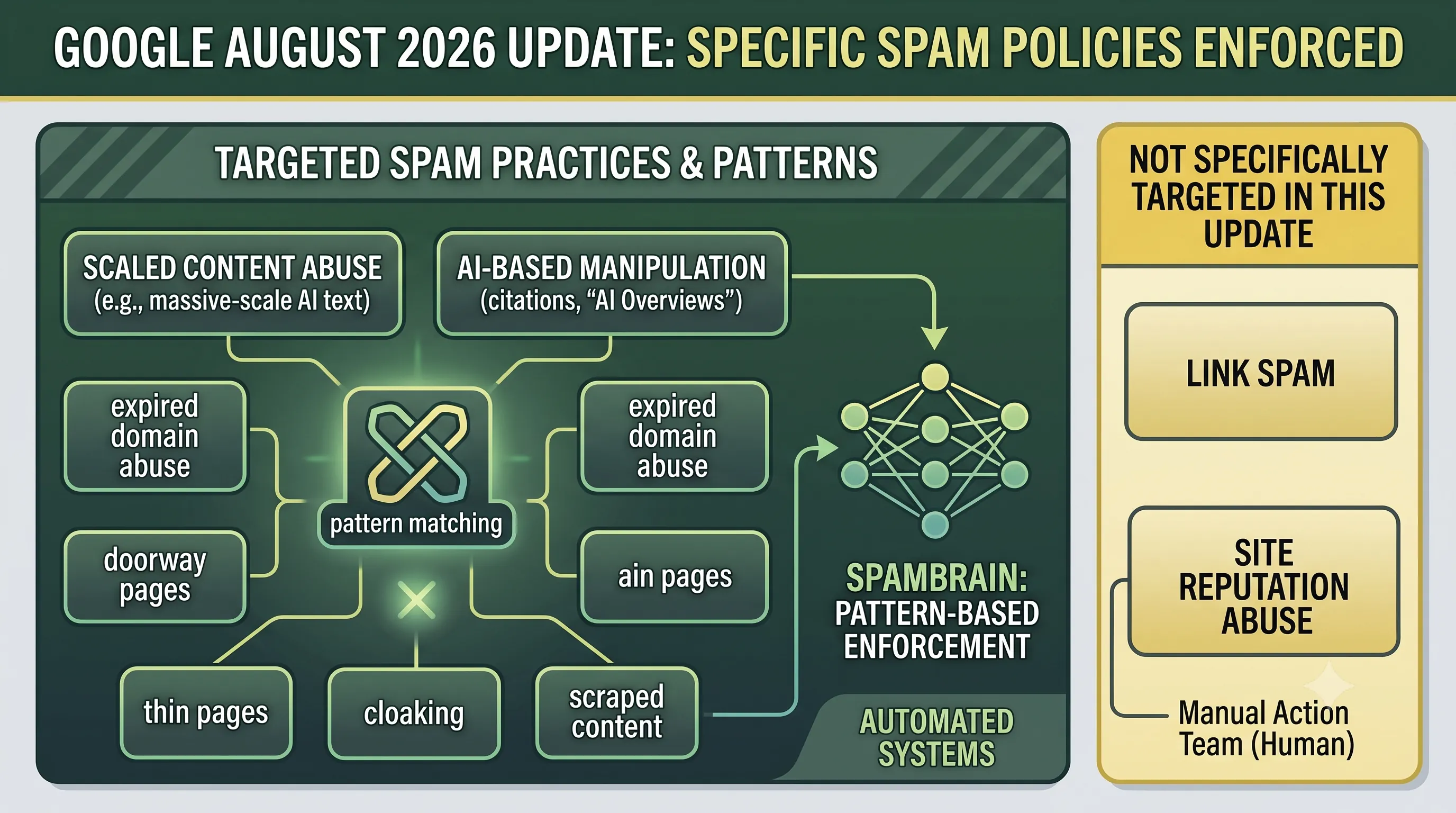
The update specifically penalized sites engaging in a range of classic spam techniques, including scaled content abuse, cloaking, doorway pages, thin pages, keyword stuffing, expired domain abuse, and the use of scraped content.
Crucially for modern content creators, the update also took direct aim at the manipulative use of generative AI.
This is a critical clarification: content churned out at a massive scale purely to farm citations and visibility in AI Overviews and AI Mode is now firmly considered a violation under spam-policy territory.
Google’s spam policies explicitly cover these attempts to manipulate its generative AI responses within Search, making it clear that low-quality, high-volume AI content designed to game the system is a primary target.
Understanding Google's Spam Policy Scope
It is important to understand that Google’s enforcement goes beyond a simple checklist of forbidden tactics.The company's automated spam-fighting system, SpamBrain, is designed to identify manipulative sites by recognizing overarching patterns of behavior rather than just penalizing individual, isolated spam techniques.
This means a site that consistently demonstrates manipulative intent, even if it cleverly avoids one specific tactic, can still be identified and penalized by the system.
This pattern-based approach is consistent with Google’s typical strategy of not naming every single tactic, which prevents spammers from simply reverse-engineering the update's exact parameters.
What Wasn't Targeted in This Update
Equally important is understanding what this specific update was not designed to address.Based on reporting from industry observers like Barry Schwartz at Search Engine Roundtable, the August 2026 spam update did not specifically target link spam.
Similarly, the update did not specifically target the site reputation abuse policy.
This is not because these issues are ignored, but because they are handled by separate, dedicated systems within Google's broader anti-spam efforts.
Site reputation abuse, for instance, is an issue that is largely handled through manual actions by Google's team, placing it outside the scope of this automated, algorithm-focused update.
3. First-Hand Impact: Community Reports and Volatility Trackers
This section details the immediate, observed consequences of the Google August 2026 Spam Update as reported by the SEO community and data tracking tools.Understanding this real-world impact—the volatility, traffic loss, and indexing problems—provides the critical context for why the survival principles discussed in the main article are so essential for AI-driven blogs.
Tracking Search Volatility Across Platforms
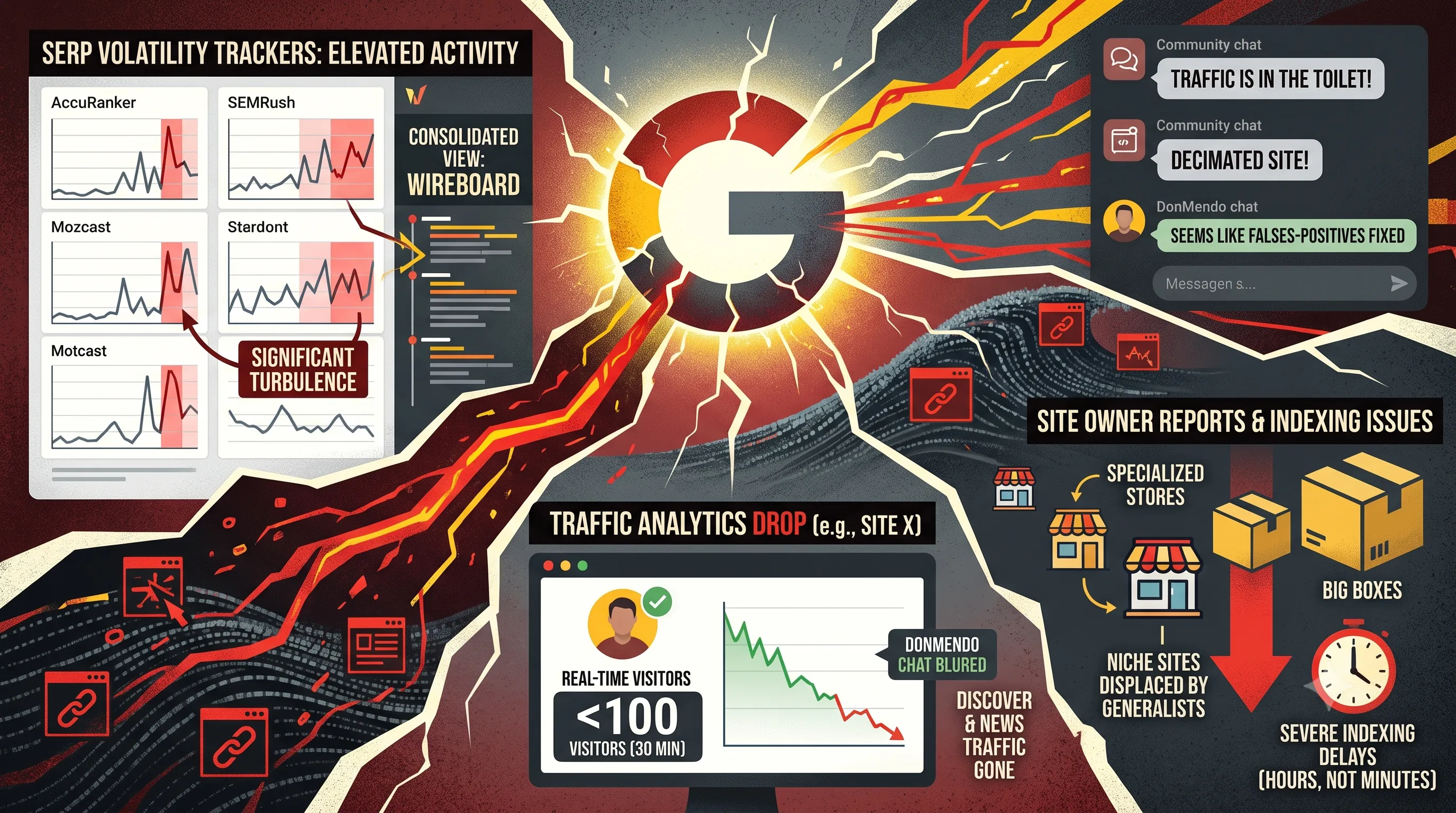
From the first day of the rollout, the impact was immediately visible across numerous third-party search engine volatility trackers.These platforms, which monitor daily fluctuations in search engine results pages (SERPs), began showing elevated movement and significant turbulence.
While the degree of change varied by provider, the consensus pointed to a substantial shake-up.
The monitoring was widespread, with data coming from a comprehensive set of industry tools.
One platform, Wireboard, is noted for aggregating data from various of these third-party tracking tools, providing a consolidated view of the market's instability.
| Volatility Tracking Providers Reporting Activity |
|---|
| AccuRanker |
| Algoroo |
| AWR |
| CognitiveSEO |
| DataForSEO |
| Mangools |
| Mozcast |
| SEMRush |
| Serpstat |
| SimilarWeb |
| Sistrix |
| Wincher |
| Zutrix |
Reported Traffic Drops and Indexing Issues
While the trackers showed algorithmic shifts, site owners reported tangible, and often severe, consequences.Google did not state the percentage of queries or searches impacted by this update, leaving webmasters to interpret the effects based on their own analytics and community chatter.
Some users reported catastrophic traffic drops, with one describing their site's traffic as "in the toilet" and another stating it was "decimated."
In a specific example of this downturn, one site owner's real-time analytics showed fewer than 100 visitors over a 30-minute period, a stark decline from normal levels.
The impact was particularly acute for sites relying on Google's content discovery platforms.
Multiple reports indicated that traffic from Discover and Google News was "all gone."
Compounding this issue were severe indexing delays for these platforms; fresh news stories that would normally be indexed in minutes were now taking hours to appear, crippling the visibility of timely content.
Community Anecdotes on Site Performance
Beyond raw traffic numbers, webmasters shared specific, qualitative changes in the search results that affected their businesses.A recurring complaint involved niche sites being displaced by large, generalist resellers.
For instance, in Germany, specialized sites reportedly lost rankings to major retailers like Obi, Bauhaus, and Expert, even for niche queries where these large stores are not known authorities.
A significant criticism of this shift was that these large reseller pages often lack additional information beyond the basic manufacturer descriptions, offering less value to the searcher than the displaced niche content.
However, the feedback was not universally negative.
One user, DonMendo, offered a contrasting perspective, stating, "Seems like the latest Spam Update fixed the false-positive issue," suggesting that for some, the update corrected previous ranking errors and improved their visibility.
4. Expert Insights: Why 'Good' Sites Are Caught and What's Next
This section provides expert commentary on the nuances of the recent spam update, explaining why sites that appear legitimate were penalized.It connects directly to the main topic by analyzing the specific manipulative tactics, often seen in scaled AI-generated content, that Google's SpamBrain now targets, offering a crucial warning and recovery path for AI-driven blogs.
SpamBrain's Evolving Detection of Manipulative Patterns
A key takeaway from the latest update is that Google's detection systems are evolving beyond catching obvious spam.Industry expert Marie Haynes (@Marie_Haynes) noted a significant trend where SpamBrain has been increasingly catching seemingly 'good' sites that are engaging in manipulative patterns.
These are not necessarily low-quality spam sites but rather platforms using sophisticated techniques to game the system.
Haynes has observed several patterns since the August 2025 spam update that signal this shift, highlighting that SpamBrain's machine-learning capabilities for detecting manipulation have become much sharper.
| Manipulative Pattern | Description |
|---|---|
| Artificial Links | Pages are propped up by links that were intentionally built or acquired, rather than earned naturally. |
| Scaled Content | Content is produced at a large scale with the primary goal of ranking in search engines, rather than serving genuine user needs. |
This sentiment is echoed by fellow expert Glenn Gabe (@glenngabe), who has been documenting the rise of AI-generated content spam for months.
Gabe expressed hope that this update would further reduce the prevalence of modern spam tactics like GEO (Google Enhanced Optimization) and AEO (AI Engine Optimization).
The 'Blast Radius' for Content Not Created for Users
The core principle behind these penalties is user-centricity.According to Marie Haynes, if your content is the type that would not exist without search engines, it likely falls within SpamBrain's 'blast radius'.
This is a critical litmus test for publishers, especially those using AI, to determine if their content strategy is fundamentally aimed at providing value to people or simply capturing search traffic.
It's important to remember that spam updates are ultimately a zero-sum game.
When spammy or manipulative sites lose their positions, those rankings are reallocated, meaning legitimate, helpful sites gain visibility and traffic.
Recovery Timelines from Automated Spam Updates
For site owners who found themselves negatively impacted by the update, Google's advice is direct: conduct a thorough review of its spam policies to identify and correct any areas of non-compliance.However, recovery is not an immediate process.
Google has clarified that recovery from spam update hits can take many months.
This is because improvements are often not recognized until Google runs periodic refreshes of its spam systems.
A site must not only fix its issues but then wait for the next refresh cycle to be re-evaluated, making patience and a commitment to long-term compliance essential.

5. Surviving the Spam Update: Principles for AI Writing Blogs
This section provides the actionable framework for the principles discussed in our main topic. While the main article outlines the 'what' and 'why', this deep dive focuses on the 'how'—offering specific recovery steps for affected sites and outlining a sustainable, long-term strategy for building a resilient AI-assisted content operation that aligns with Google's quality standards.Immediate Steps for Recovery and Remediation
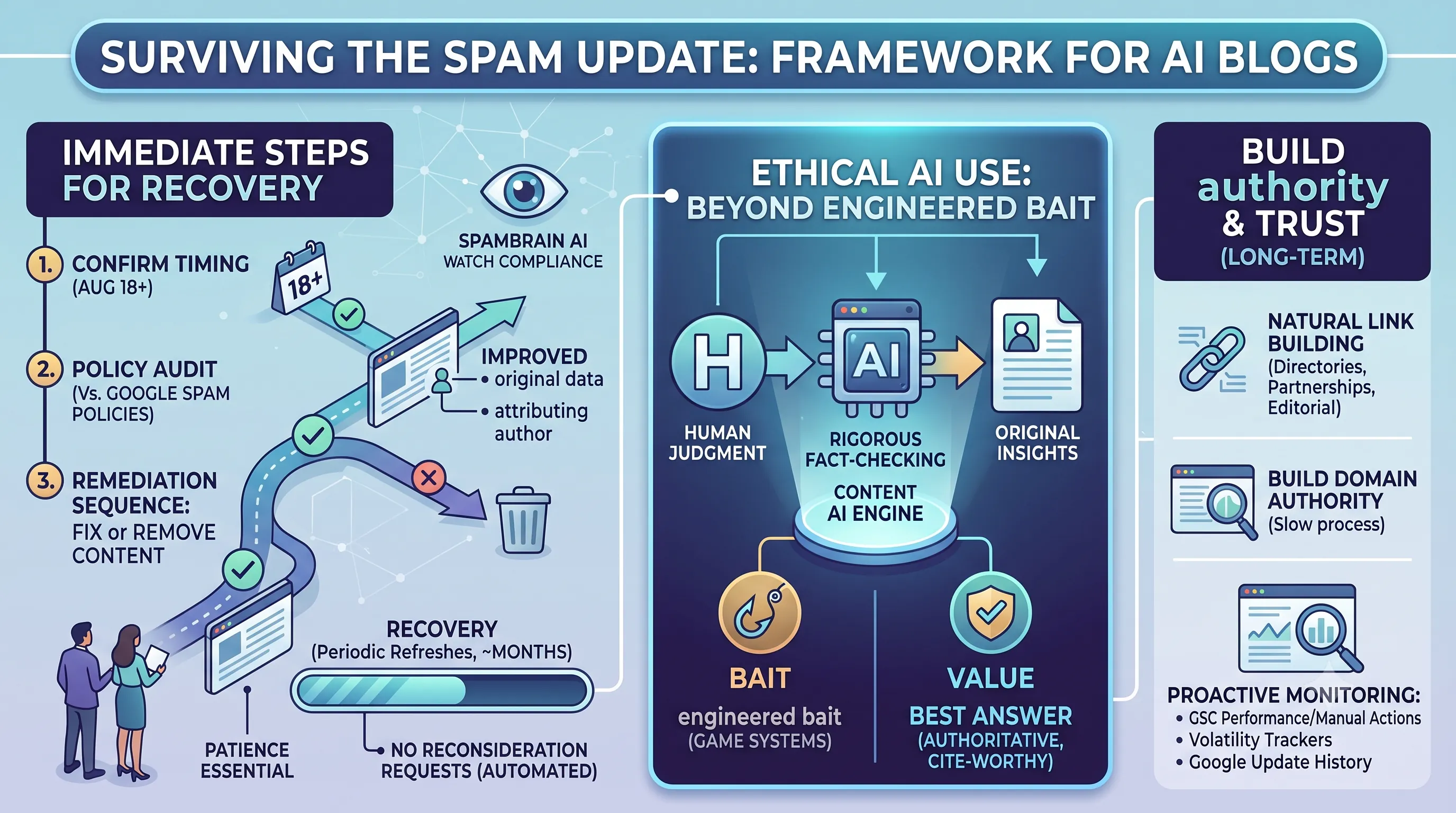
For sites experiencing a negative impact, recovery begins with a systematic and patient diagnosis, not panicked changes.The first action is to confirm the timing of any traffic drop against the August 18th start date of the spam update.
If the dates align, the critical next step is to identify the specific policy violation by conducting a thorough audit of your site against Google's official spam policies.
This audit should focus intently on the areas SpamBrain is designed to target, as outlined in the section on Specific Spam Policies Enforced (Section 2), such as scaled content produced at a high volume with little value, AI-generated articles lacking genuine expertise, and other attempts to manipulate search rankings.
Once problematic content is identified, a remediation sequence must be initiated.
This involves either fixing or removing the offending pages.
For content that has potential value, the focus should be on significant improvements, such as injecting first-hand experience, adding original data, and attributing the work to real authors with demonstrable expertise.
Conversely, any pages that cannot carry real value and serve no user purpose should be deleted entirely.
It is crucial to understand that recovery from automated spam systems is a slow process; as discussed in Section 4, improvements are often not recognized until Google runs periodic refreshes of its spam systems, which can take many months. Patience is essential.
Furthermore, reconsideration requests are not an option for automated updates; they only apply to manual actions.
If your site's core business model was built on a "publish at volume, rank, and monetize" framework, this update signals that a fundamental change in your overall content strategy is required for long-term viability.
Ethical AI Use: Beyond Engineered Bait
To protect a site from future updates, the approach to AI must shift from a content generator to a productivity tool.The most resilient strategy involves using AI assistants for initial drafts or research, but never as the final publisher.
Every piece of content must be filtered through human judgment, subjected to rigorous fact-checking, and enhanced with original insights that an AI cannot replicate.
The ultimate goal is to structure content so that it becomes the best possible answer to a user's query—so authoritative and well-presented that even other AI engines would be compelled to cite it.
This stands in stark contrast to creating content that is merely engineered bait, designed to trick algorithms rather than serve users.
Building Authority and Trust Long-Term
Sustainable success requires moving away from shortcuts and focusing on foundational, long-term authority building.This involves earning links naturally through legitimate methods like listings in real directories, strategic partnerships, and genuine editorial mentions from other reputable sites.
Building domain authority is a slow and deliberate process that cannot be rushed.
To stay ahead of potential issues, it is vital to maintain a consistent monitoring habit.
Regularly check Google Search Console for performance data and manual actions, keep an eye on industry volatility trackers for signs of algorithm shifts, and follow Google's official update history page for confirmed rollouts.
This proactive monitoring provides the awareness needed to adapt before a minor issue becomes a site-wide problem.
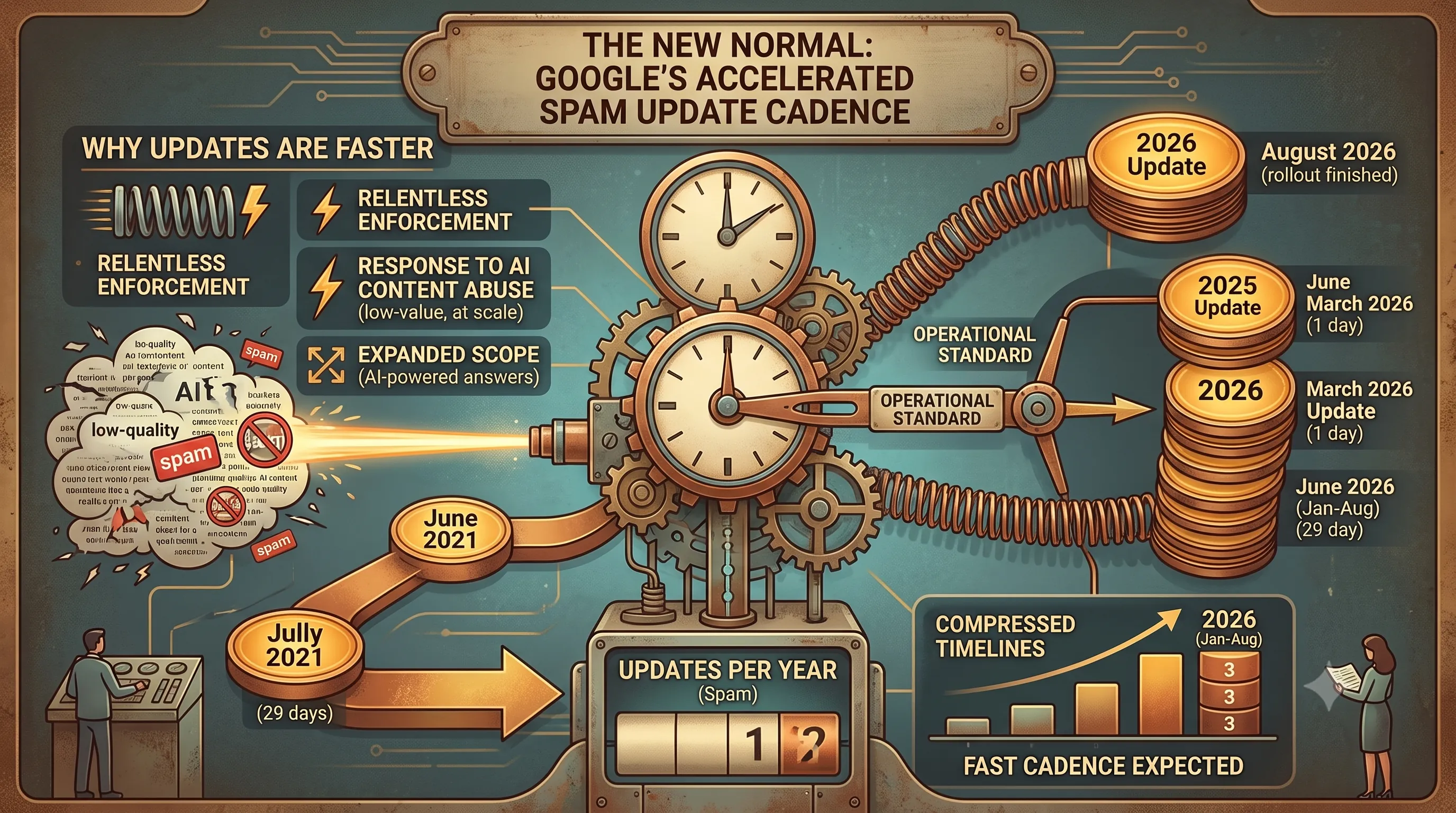
6. The New Normal: Google's Accelerated Spam Update Cadence
This section contextualizes the recent August 2026 spam update by examining the broader trend of Google's increasingly frequent and rapid algorithm rollouts. Understanding this accelerated pace is fundamental to grasping why new survival principles are essential for blogs, especially those leveraging AI for content creation, as it directly reflects Google's strategic response to modern web spam tactics.Why Spam Updates Are Faster and More Frequent
The rhythm of Google's algorithm changes has become noticeably faster, establishing a new operational standard for SEOs and webmasters.The first eight months of 2026 alone saw three significant spam updates in March, June, and August, signaling a relentless enforcement schedule.
This increased frequency and speed are a direct reaction to the proliferation of low-value websites created at scale using cheap AI generation tools.
As spammers accelerate their content production, Google has compressed its update rollouts from what once took weeks to, in some cases, less than a single day.
This fast cadence is expected to continue, with Google's policy enforcement is also anticipated to expand into new areas like AI-powered answer results.
A Historical Look at Google's Spam Update Rollouts
A review of spam-related updates since 2021 clearly illustrates this trend toward compression.While longer rollouts like the 29-day July 2021 link spam update or the 27-day August 2025 update were common, recent updates have been executed with remarkable speed.
For example, the March 2026 spam update was completed in just one day, a stark contrast to the multi-week timelines of the past.
The following table details the rollout history of key spam and link spam updates, highlighting the evolution of Google's deployment speed.
| Update Name | Start Date | Completion Date | Rollout Duration |
|---|---|---|---|
| June 2021 Spam Update (Part 1) | June 23, 2021 | June 23, 2021 | 1 day |
| June 2021 Spam Update (Part 2) | June 28, 2021 | June 28, 2021 | 1 day |
| July 2021 Link Spam Update | July 26, 2021 | August 24, 2021 | 29 days |
| November 2021 Spam Update | November 3, 2021 | November 11, 2021 | 8 days |
| October 2022 Spam Update | October 19, 2022 | October 21, 2022 | 2 days (48 hours) |
| December 2022 Link Spam Update | December 14, 2022 | January 12, 2023 | 19 days |
| October 2023 Spam Update | October 4, 2023 | October 20, 2023 | 15 days |
| March 2024 Spam Update | March 5, 2024 | March 20, 2024 | 15 days |
| June 2024 Spam Update | June 20, 2024 | June 27, 2024 | 7 days |
| December 2024 Spam Update | December 19, 2024 | December 26, 2024 | 7 days |
| August 2025 Spam Update | August 26, 2025 | September 22, 2025 | 27 days |
| March 2026 Spam Update | March 24, 2026 | March 25, 2026 | 1 day |
| June 2026 Spam Update | June 24, 2026 | June 26, 2026 | 2 days |
7. References
- https://www.seroundtable.com/google-august-2026-spam-update-done-41906.html
- https://saascity.io/blog/google-august-2026-spam-update
Related Posts

Analysis of Illicit Industrial-Scale Model Distillation and Chain-of-Thought Extraction CampaignsA technical report on illicit industrial-scale distillation campaigns targeting Claude, detailing...

A Guide to Building Sovereign AI Infrastructure with Mistral Self-Hosted StacksLearn how to build sovereign, air-gapped AI infrastructure using Mistral's self-hosted enterprise...

Alibaba Qwen 3.8 Max vs. OpenAI GPT-6 Astra: Architectural and Economic AnalysisAn in-depth technical comparison of Alibaba Qwen 3.8 Max and OpenAI GPT-6 Astra, covering...